
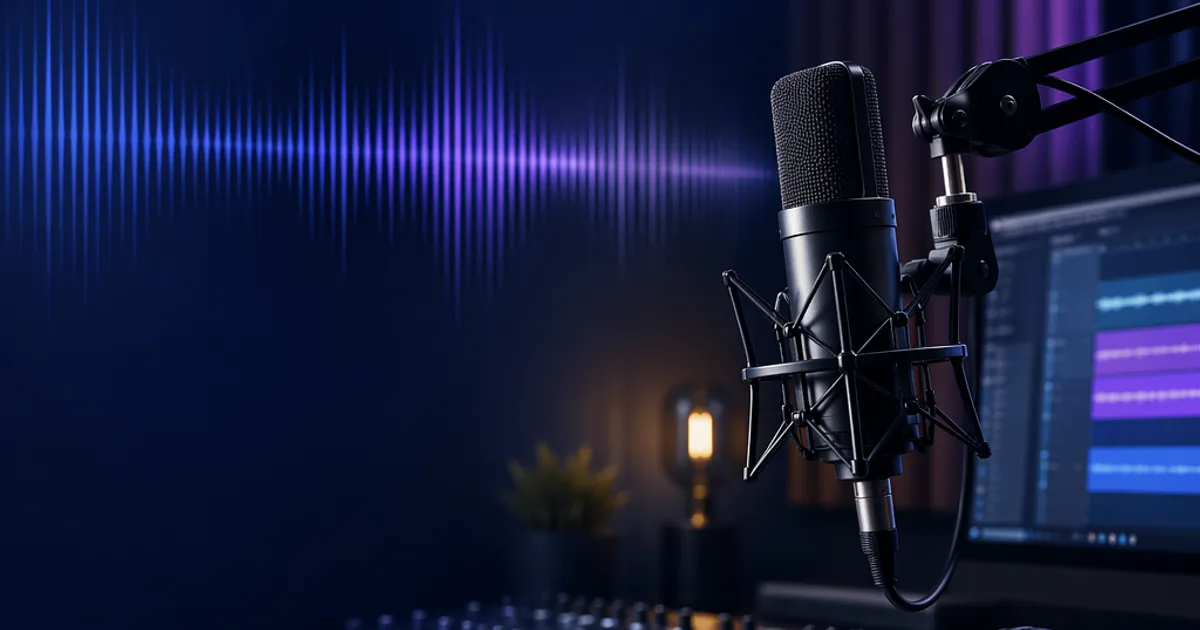
Emotional Sound Design for Podcast Storytelling
Published on 11/6/2025 • 5 min read
Below I’ll walk through how to use those elements intentionally: why music is your emotional backbone, how ambience places a listener inside a scene, when silence does the heavy lifting, and how to balance all of it so voices remain clear and honest. I’ll share practical approaches, two concrete episode anecdotes with measurable outcomes, and a compact DAW playbook you can replicate in any editor.
Why sound design matters more than you think
Audio is imagination fuel. Unlike film, a podcast can’t show a face, a setting, or a gesture. Your listeners’ brains fill in the blanks — and sound steers that imagination. Music cues expectation (danger, tenderness, triumph). Ambience gives context (a café, a subway, a storm). Silence directs attention the way punctuation shapes a sentence.
Early on I treated sound design as garnish. That was a mistake. When you design with emotion in mind, each sonic choice becomes narrative — a tiny guide that tells the listener where to feel, when to lean in, and how to remember.
Music: the emotional backbone
Music is powerful because it’s associative and immediate. A few notes can switch mood faster than ten lines of dialogue. But it’s not about slapping any track under the whole episode. It’s about placement, instrumentation, and restraint.
How I choose music
I start with one question: what do I want the listener to feel in this moment? Calm empathy? Unease? Triumph? That intention narrows choices quickly.
Tempo, instrumentation, and arrangement matter. Slower tempos give space; faster tempos push urgency. Strings can sound brittle; nylon guitar feels intimate. A practical option is stems or short loops so I can shape dynamics around speech rather than fighting a long, busy track.
Practical tip: sidechain music gently under vocals to avoid masking — it ducks the music when speech is present without sounding obvious.
Where music works best
- Intros and outros: short motifs create cohesion.
- Underscores under dialogue: keep them low and simple.
- Transitions and beats: swells or hits to punctuate reveals.
Ambience: building believable worlds
Ambience is the stage designer of audio. It fills the visual gap by offering environmental cues that orient the listener’s attention. Specificity and layering are the tricks.
Ambience vs. sound effects
- Ambience: continuous texture (room tone, distant traffic).
- SFX: discrete events (door slam, footsteps).
A believable environment is a stack: distant hums, intermittent accents, and nearby textures. Each layer lives in its own frequency and dynamic space so the brain reads them as one place.[1]
Ambience to guide emotion
Practical workflow: record room tone when possible, EQ to carve space for dialogue, and automate ambience levels between scenes.
Silence: the underestimated powerhouse
Silence scares hosts and editors. But used deliberately, it’s enormously revealing. Silence creates contrast and gives weight to what comes before and after.
How silence changes perception
Guideline: short, dramatic pauses after key lines work better than long stretches of emptiness. Pair silence with a subtle room‑tone drop so the ear knows this moment is different.
Sound effects: small details, big impact
Foley and SFX prove you cared. A creak, distant siren, or jacket rustle makes scenes tactile — but only if they serve the story.
- Less is more. Choose SFX that emphasize narrative beats.
- Match perspective: close or distant should reflect the narrator’s point of view.
- Timing matters: a footstep 80 ms off breaks immersion; get the rhythm right.
Mixing for clarity and emotion
A clever design plan can fail at the mix. Voices must be intelligible and natural-sounding; music and ambience should support rather than obscure.
Voice first
Always mix for speech. If listeners struggle to hear dialogue at comfortable volumes, the emotional design is moot. Use EQ for presence (often a gentle boost around 2–5 kHz), cut competing frequencies in music/ambience, and use compression sparingly to keep dynamics focused.[2]
Automation like painting
Treat automation as micro-direction. Raise ambience during scene-setting, lower it for dialogue, and let underscores bloom after important phrases. Small, intentional moves create motion without drawing attention.
Reference listening
Check your mix on monitors, earbuds, laptop speakers, and in the car. Each reveals different problems. If something fails on one system, iterate.
Common pitfalls and how to avoid them
- Over-saturation: too many elements dilute emotion.
- Constant crescendos: save big moves for genuine climaxes.
- Tone mismatch: a bright track will undercut a somber confession.
- Erased pauses: small silences give necessary breathing room.
Mini-playbook: exact DAW settings and parameters you can copy
This baseline works in Reaper, Pro Tools, Logic, or any DAW with routing and automation.
Track setup:
- Dialogue: 48 kHz, 24-bit. High-pass at 80 Hz.
- Music: stereo stem, -6 dB gain staging.
- Ambience: stereo, -12 to -18 dB fader start.
Voice EQ/compression:
- HPF 80 Hz (12 dB/oct).
- +2–+4 dB around 2–4 kHz for presence.
- Cut -3 to -6 dB in 300–500 Hz if boxy.
- Compressor: 3:1 ratio, 10–20 ms attack, 80–120 ms release, ~3–5 dB gain reduction on peaks.
Music sidechain:
- Send voice to a bus; compressor on music listens to that bus.
- Start: 2:1 ratio, 1–5 ms attack, 120–200 ms release, duck 3–6 dB on speech.
Ambience automation:
- Scene-setting: +6–8 dB for 10–15 sec.
- Dialogue: automate down 4–8 dB or sidechain with longer release (200–400 ms).
Final export:
- Target -16 LUFS integrated (stereo podcasts).
- True peak < -1.0 dBTP.
This playbook is conservative — start here and tweak for voice, genre, and platform.
Exercises to sharpen emotional sound design
- The 30-second underscore: try minimal piano, ambient pad, and no music under the same narration.
- Ambience swap: replace a scene’s background (city vs. countryside) and note how mental images change.
- Silence spot: after a pivotal line, add one extra second of silence and listen for impact.
These drills train you to hear choices as emotional tools, not cosmetic bells.
Resources Use and recommend
- Curated music library: 10–15 short tracks organized by mood.
- Ambience packs labeled by perspective (close, mid, distant).
- A few home-recorded Foley items (door, footsteps, cup clink).
- Any DAW with automation; Use Reaper for lightweight, powerful sessions.[3][4]
When less becomes more: intentional restraint
The editorial test is simple: highlight or be quiet? My rule: highlight when amplification serves the moment; be quiet when honesty will land harder. Unadorned voice and a breath often beat the most elaborate string section.
In a piece about grief I removed nearly all flourishes. Listeners called the scene "authentic," completion rose, and social shares spiked — restraint won.
Final checklist before you publish
- Can you hear every word on multiple systems?
- Does each music cue serve an emotional purpose?
- Are ambiences and SFX perspective-appropriate?
- Did you use silence intentionally?
- Have you listened through after a break with fresh ears?
Answering these moves an episode from "well-made" to "felt."
Personal anecdote
Micro-moment
During a rush edit, I replaced a noisy café ambience with a thin indoor room tone and a single cup-clink SFX. The scene stopped feeling like background noise and started feeling like a presence. Listeners leaned in; so did I.
Emotion in audio isn’t decoration — it’s direction. Use sound to point the listener where to feel, and then get out of the way.
References
Footnotes
-
IWayThrills. (n.d.). Sound design for podcasts. IWayThrills. ↩
-
Adobe Podcast. (n.d.). The role of sound design in podcasting. Adobe Podcast. ↩
-
AudioAudit. (n.d.). The art of storytelling: techniques for crafting engaging podcast narratives. AudioAudit. ↩
-
Cue Podcasts. (n.d.). Podcast storytelling guide. CuePodcasts. ↩